


 Posts
Posts



To account for the misery caused by the housing bust, we tweaked the methodology for this year's list and considered foreclosure rates and the change in home prices in the past three years.
Here are the top 10 most depressed cities in the country.

Unemployment here has averaged 14.3% in the past three years, which is third-worst in the country among the 200 largest metropolitan areas. The housing market collapsed as well, with home prices down 58% in the same time.
All of the California cities on the list are struggling with the state's inherent problems, including high sales and income taxes and service cuts to help close massive budget shortfalls.

The sun and lack of a state income tax are the only things keeping Top Spot Miami out
Foreclosures hit one in 14 homes last year. Corruption is off the charts, with 404 government officials convicted of crimes this past decade in South Florida.

The economic downturn and busted housing market hit Merced harder than any other area in the country. Average unemployment of 16.2% since 2008 is the highest in the U.S., as is the city's 64% drop in its median home price.

The median home price here was $275,000 in 2006; today, it is $95,000. And don't leave your car on the street in Modesto, where 3,712 vehicles were stolen in 2009, the second-highest auto-theft rate in the country. The city ranked first in four of the previous five years.

No state taxes $50,000 of income like California, which has a rate of 9.55% for that middle-class tax bracket.
Sacramento is a one-team sports town, and that team has been awful in recent years. The NBA's Kings have won just 26% of their games in the past two-plus seasons.

Tennessee is one of nine states without an income tax; it does tax dividends and interest income. But it hits residents with one of the highest sales-tax rates in the U.S. at 9.25%.
Violent crime was down 5% in 2009 in Memphis, according to the FBI, but it still is tops in the country.

Baseball's Cubs used to be lovable losers, but $140 million payrolls and 102 years without a World Series title are miserable. Chicago had the highest sales tax among big cities at 10.25%, but it was rolled back to 9.75% in 2010 and now matches Los Angeles and Oakland, Calif., for the top rate.

The West Palm Beach-Boca Raton, Fla., area might sound glamorous, with its beaches and million-dollar oceanfront homes. The reality is much different.
The median home price here is $225,000, down 39% the past three years. Prices are expected to fall an additional 22% this year as foreclosures continue to affect the housing market. The area's unemployment rate was recently 12.3%.

This one-time Navy town became the largest California city to file for bankruptcy when it entered Chapter 9 protection in 2008. Unemployment is expected to average 12.5% this year, up from 4.9% five years ago.

Last year's most miserable city drops back, thanks to a housing market that never overheated and therefore hasn't crashed as it has in other areas. The weather is lousy, corruption is persistent and it's a tortured sports market, with no championships since 1964. LeBron James' departure from the NBA's Cavaliers delivered the latest cruel blow last summer.


 The young girl remembers she loved the smell of washing powder on her mother’s cardigan and on her bed sheets, and so do many other people, but that doesn’t make them want to stuff their face with the toxic substance. But that’s exactly what Tempestt felt when she first dipped her fingers in washing powder and licked it off. ‘I dabbed the powder onto my tongue and it tasted so sweet, and salty…it just felt so right. I was hooked straight away.’ says the young nursing student.
 Six months passed since her unnatural craving for soap and washing powder set in, and Tempest was finally beginning to realize the dangers she was exposing herself to, so she sought medical advice. She was immediately diagnosed with PICA, a rare condition that causes people to eat non-nutritive substances like metal, chalk and even sand. It’s usually caused by mineral deficiency, but in Tempestt’s case, the condition is believed to have been caused by stress. The girl’s boyfriend had broken up with her, before heading off to college, and she says that simply devastated her.
 Regardless of what caused her to start eating soap and washing powder, Tempestt needed to stop as soon as possible, as the complications from ingesting such toxic chemicals were putting her life at risk. Doctors gave her intensive Cognitive-behavioral therapy, to help her think of positive things when she felt like eating soap, and also encouraged her to get out more, take long walks, and avoid places where soap or detergent are available, like bathrooms and laundromats…She’s using liquid soap now, and for some reason it doesn’t appeal to her at all.
 Tempest Henderson has been “clean” since September 2010, and hopes she will never give in to eating soap or washing powder ever again, but she knows she still faces a long road of recovery.
 this is an attempt to make a tutorial for making your own iron age/viking shoes. i don't have a pattern for these; i learned to make them by using my own foot as a template. therefore, all the measures given here are highly approximate. if your foot diverges a lot from mine (size 39, long and narrow/slender), some sewing experience might come in handy. that said, there's no reason to be too specific in making these. as you can see, the 'laces' can be loosened or tightened to fit, and the basic idea is really very simple.
 by following the description, you should end up with something that looks like this (above. never mind the red dots in the picture - they will be explained later). the uncut shoe is my left foot (wrong side out), but the cut, dark one is my right foot shoe (right side out). (i'm sorry for the bad quality photos. i don't know what's wrong with my camera - the top photo was taken about two years ago; crisp, clear and fine. all the photos i take these days come out pale and grainy).
 then mark the center point under your forefoot; the part that you use to kick off when you walk. (wow. pay attention. more bad english will follow). using a ruler, draw a vertical line through this as shown.
 draw another line under this one. using my foot as a measure, this will be approximately 2,5 centimeters below the first line. yours might be different, but take a look at where the line is placed on the foot; just below the big knuckle on the inside of your foot. the top line is just above it.
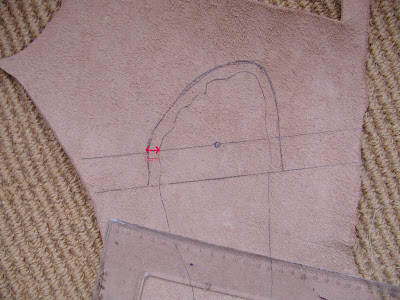 draw a line about 1 cm outside the foot line, around the toe area. omit the bumps (your toes...)
 mark several points about 5,5 cm outside of this again. draw a line through the points (i forgot to do it at this point and did it later on, see below. it's hard making a tutorial; you have to think in logical steps instead of doing the messy thing you usually do!) .
 draw the heel cap, about 2 cm wide and 4 cm long. mark three lines (the dotted red lines) - these points mark the end of the heel part (the bottom line), and also between the 'ears' that comes next (the two upper lines). again, there is little point in giving measures here, but look again at where the lines are placed on the foot. and remember it's all very approximately. the shoe can be made with both two or three 'ears'. these are made with three. if you're good at eye measurements (?), this step can be omitted completely.
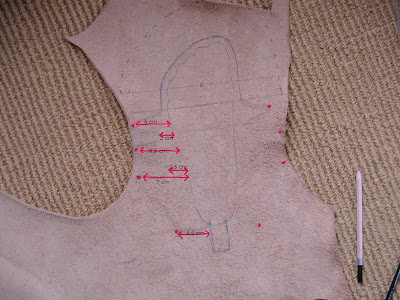 here comes the free hand drawing. sketch up the 'ears' using a soft pencil. i have given measures here; again, only guidelines. i have marked the outer most point of the ears with red dots. you can (barely!) see here where the three lines from the previous photo are; in between the three ears, and at the end of the heel ear.
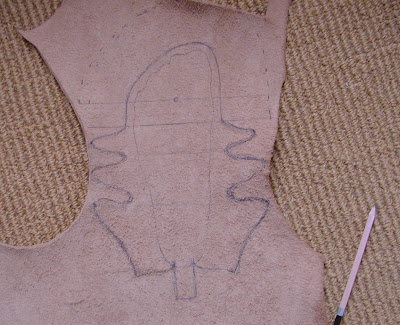 when you are happy with your drawing, make a more solid line.
 the next step can also be omitted, but is helpful as a visual guide: using a ruler, draw a fan from the middle point of your forefoot to the line you made 5,5 cm outside your toes. in addition, you will draw lines in the 2,5 cm area below the toe area, as shown. this will be the 'fingers' that wraps around your toes. as you can see from picture #2, there is some space between some of the 'fingers' in the top section of the fan. there's no rules to this; the point is just to make them fit nicely around your toes. the only thing i would make sure of, is not to cut the fingers slimmer than 1 cm. but differing somewhat from each other in size is not a problem.
 start cutting.
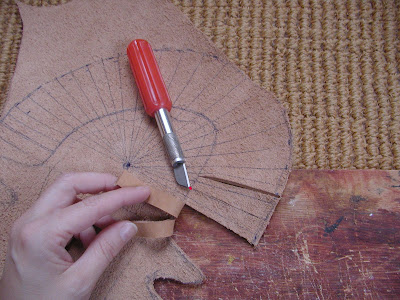 and here's why drawing the fan can be omitted (at least by me); you might just decide to ignore the lines while cutting. but they're good as a visual aid. cut he fingers up until the 1 cm line, as shown by the red dot at the tip of the knife.
 cut the fingers so that they seem functional, with a little space between some of them. you might wish to round off the tip of the fingers just a little by cutting the corners, but this is optional.
 draw a leather string through the holes as shown here and in picture #1, and try the shoes on (preferably on your own foot :) )
 pull your leather string through the two bottom holes in the middle section, as shown, so that the string have equal lengths on both sides of the cap. i cut my own leather strings, but you can buy pre cut strings for this.
 then, from the inside, pull the string through
  push the string through
  then 'sew' back through side flap hole nr 3 and middle section hole nr 4; pull tight and it will look like this:
 repeat on the other side and cross the strings:
 cross again on the inside of the cap, and pull through the last two holes. inside view:
 tie a knot, and you're done.
 (the front part of the shoe is 'unstringed' in this picture, that's why the sides are sticking out.)


